This post is a tribute to the Boston Bruins fourth line legacy, specifically the Merlot Line – the trio of Gregory Campbell, Shawn Thornton, and Daniel Paille who defined gritty, grinding hockey at TD Garden from 2010 to 2014. Written from the perspective of a lifelong Bruins fan who spotted a Gregory Campbell Bruins sweater in the crowd during the 2025-26 season, it covers the Merlot Line Boston Bruins history, the heavyweight fight record of Shawn Thornton Bruins fans still talk about, and the moment Gregory Campbell broke his leg on the penalty kill against Pittsburgh and refused to leave the ice.
Walking Into a 6-1 Bloodletting
Walking into the Garden yesterday for the 6-1 bloodletting, I saw a gentleman wearing a Gregory Campbell sweater.

In addition to it being one of the most random jerseys in the raucous crowd, it made me think about how much the beloved Boston Bruins faithful love a good fourth liner. We suffer through losses like yesterday’s with a quiet, grim dignity. But you see a Gregory Campbell sweater and something clicks. You remember what this team was. You remember what it felt like to watch a line that would run through a wall for you and not ask for a damn thing in return.
The Merlot Line Boston Bruins era ran from roughly 2010 to 2014. Campbell, Thornton, and Paille. They were an interesting bunch, and not in the way that gets you a 10-team bidding war in free agency. Interesting in the way that made you feel like the guy next to you at the bar actually played for your team. (Which is the highest compliment I can give, for the record.)
The Gregory Campbell Bruins Experience: All Heart, No Quit
Gregory Campbell came over from Florida in the same deal that brought Nathan Horton to Boston. Guy was all heart.
In addition to his Boston Bruins fourth line role, he was an excellent penalty killer. And then came the moment. The 2013 playoffs, second round against Pittsburgh. Campbell is out on the PK, takes a shot off his leg, and breaks it. Clean. Right there on the ice. He can’t skate. He can barely stand. And he finishes his shift anyway – hopping on one leg, stick down, refusing to leave until the whistle blows.
THAT is what will endear you to the union labor in the balcony at the TD Garden.
Not a hat trick. Not a highlight-reel goal. A guy with a broken leg who won’t quit because quitting isn’t in his vocabulary. The building went absolutely insane. I was not there that night, but I’ve watched the clip probably forty times and it gets me every single time. (I’m not crying. You’re crying.)
The Gregory Campbell Bruins years didn’t produce a ton of points. He wasn’t going to win you a Selke. But he was the kind of player who made you proud to wear the sweater, and that counts for something. It counts for a lot, actually.
Shawn Thornton Bruins: The Heavyweight Muscle of the Merlot Line
Then there was the muscle.
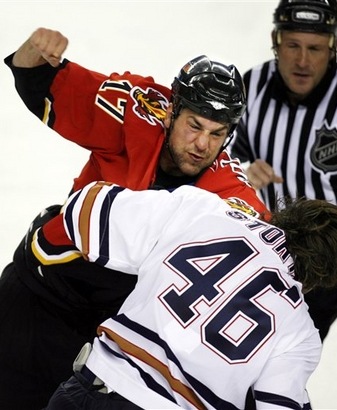
Shawn Thornton fought everyone in the heavyweight division from that era, and he did well. Check his full fight card over at HockeyFights.com if you want the receipts – the guy was a legitimate heavyweight who answered the bell every single time. He wasn’t the kind of enforcer who picked his spots. He went when it needed to happen.
But here’s the thing people forget about the Shawn Thornton Bruins years: he had sneaky good hands around the net. He could contribute offensively every now and then. He’d drop the mitts, rearrange some guy’s snot box, and then go pot a greasy goal in the next shift. It wasn’t a frequent occurrence, I’ll grant you that. But it happened enough that you never fully wrote him off as just a fighter.
The Merlot Line Boston Bruins worked because Thornton set the physical tone. You didn’t take liberties with the Bruins’ stars when Thornton was on the bench. You just didn’t. And if you tried, you were going to have a very bad night. That accountability – that’s what the fourth line is supposed to provide, and he provided it better than almost anyone in that era.
Daniel Paille Bruins: The First-Rounder Who Said “Where Do I Sign?”
Danny Paille, a former first-round pick, was fast.
He was a guy who wanted to stay in the NHL. Period. When he was asked to become a gritty fourth liner, he didn’t sulk. He didn’t demand a trade. He essentially said, “Where do I sign?” and got to work. That attitude is rarer than you’d think, especially from a guy who was drafted in the first round and probably had different dreams about what his NHL career would look like.
The Daniel Paille Bruins era gave the Merlot Line the speed it needed to actually forecheck and create turnovers. They weren’t three slow guys looking to hit people. They could skate. Paille was quick enough to chase down pucks in the corners and create zone time, which meant the line wasn’t just out there to fight and take penalties. They could actually play. (Imagine that.)
He was also a solid penalty killer. The whole line was. That’s what made them so useful – they weren’t a liability. You could put them out in any situation and trust them to do the right thing.
Why the Boston Bruins Fourth Line Still Owns the Balcony
The Boston Bruins fourth line has always held a special place in this city’s heart.

We see ourselves in those guys. They clock in, do the dirty work, and don’t complain. They’re the guys who give ‘er every single shift, who block shots without flinching, who fight when it needs to happen and skate hard when it doesn’t. The stars get the statues outside the Garden. The fourth liners get the lasting respect of the balcony, and honestly? I’m not sure which one is worth more in this town.
Seeing that Campbell sweater yesterday was a gut punch of nostalgia in the middle of a 6-1 loss. It was a reminder that this franchise has produced some genuinely great teams – teams built on exactly the kind of character that doesn’t show up in the box score. The Merlot Line Boston Bruins won a Stanley Cup in 2011. They were a big reason why. Not because of their points, but because of what they brought to the ice every night.
Frig off with the fancy analytics. Give me a broken leg on the penalty kill any day of the week. And if you want to see where the enforcer fits into the modern game, we’ve got thoughts on that too.